



















Avec le développement rapide de 5G réseaux, la demande pour réseau données transmission est croissante exponentiellement. As le sous-jacent porteur réseau, le transmission capacité de réseaux optiques est crucial à le développement des 5G réseaux. Un de la magie armes à étendre la transmission capacité de optique réseaux est à continuel creuser profond dans le disponible bande ressources de optique fibres, que est, à continuel expand the transmission chemin largeur de optique réseaux. Le large la transmission route, la transmission capacité de le réseau optique augmentera naturellement . Suivant, I parler à vous à propos ces bandes de optique fibre.
Traditionnel groupe
Après long-terme recherche par scientifiques, it was first discovered that the light with a wavelength of 850nm can be used as light for optical communication. This waveband is also directly called the 850nm waveband. Cependant, the transmission loss in the wavelength region of of the 850nm band is relativement large, and there is no suitable fiber amplifier. Therefore, the 850nm band is only suitable for short-range transmission.
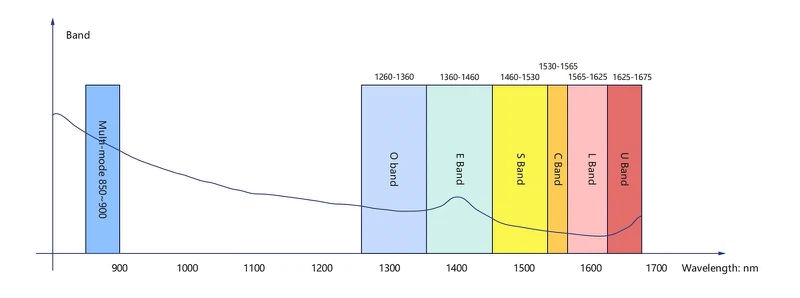
Later, scientists explored the "low-loss wavelength region" optical band, that is, the light in the 1260nm~1625nm region, which is most suit for transmission in optical fibers. See the figure below for the relationship between transmission loss and optical band.
What is an O-band?
O-band is the original band 1260-1360 nm. O-band is the first wavelength band historiquement used for optical communications, with minimal signal distortion (due to dispersion).
What is an E-band?
E-band (extended wavelength band: 1360-1460 nm) is the least common of these bands. E-band is mainly used as an extension of O-band, but there are few applications, mainly because many existing optical cables show high attenuation in E-band, and the manufacturing process is très energy-intensive, so its use in optical communication is limited.
Qu’est an S-band?
The fiber loss in the S-band (Short-wavelength Band) (short-wavelength band: 1460-1530 nm) is lower than that in the O-band, and the S-band is used as many PON (passive optique network) systems.
What is C band?
The C-band (conventionnel bande) plages de 1530 nm à 1565 nm, représentant la bande conventionnelle. optique fibre expos]la plus faible perte dans la bande C et a a plus avantage dans longue distance transmission systèmes. It is usually used in many metropolitan, long-distance, ultra-long-distance and submarine optique transmission systems combined with WDM and EDFA technologie. La bande C devient plus et plus important comme transmission distances deviennent plus longues et fibre amplificateurs sont utilisés à la place de optique-à-électron-à-optique répéteurs. L utilisation de bande-C étendue avec le avènement de DWDM
What is L-band?
L-band (Long-wavelength Band) (long-wavelength band: 1565-1625 nm) is the second lowest-loss wavelength band and is often used when the C-band is not enough to meet the bandwidth requirements. With the wide availability of b-doped fiber amplifiers (EDFAs), DWDM systems have been extended up to the L-band, and were initially used to extend the capacity of terrestrial DWDM optical networks. Maintenant, it a été introduit à sous-marin câble opérateurs à faire la même chose - étendre le total capacité de sous-marin câbles.
Parce que la transmission atténuation perte de les deux transmission fenêtres de la bande C et la bande L est le plus petit, le signal lumière dans le DWDM système est généralement sélectionné dans la bande C et la bande L. In addition à la Bande O à la L-bande, là sont deux autres bandes, le 850 nm bande et la U-bande (ultra-longue bande: 1625-1675} nm). Le 850 nm bande est le dominant longueur d’onde pour multimode fibre optique communication systèmes incorporant VCSELs (vertical cavité surface émission lasers). La U-band is principalement used for network monitoring.